Offer choices
Provide several musical possibilities. Let the learner listen, compare, change them or reject them all.
MusEDLab / Active research & development
Designing tools for the person who is learning.
How can AI help us develop musical judgment, skill and our own ideas? Rengongfu explores tools that leave meaningful decisions with the learner and make the process of making music visible.
Explore the design approach ↓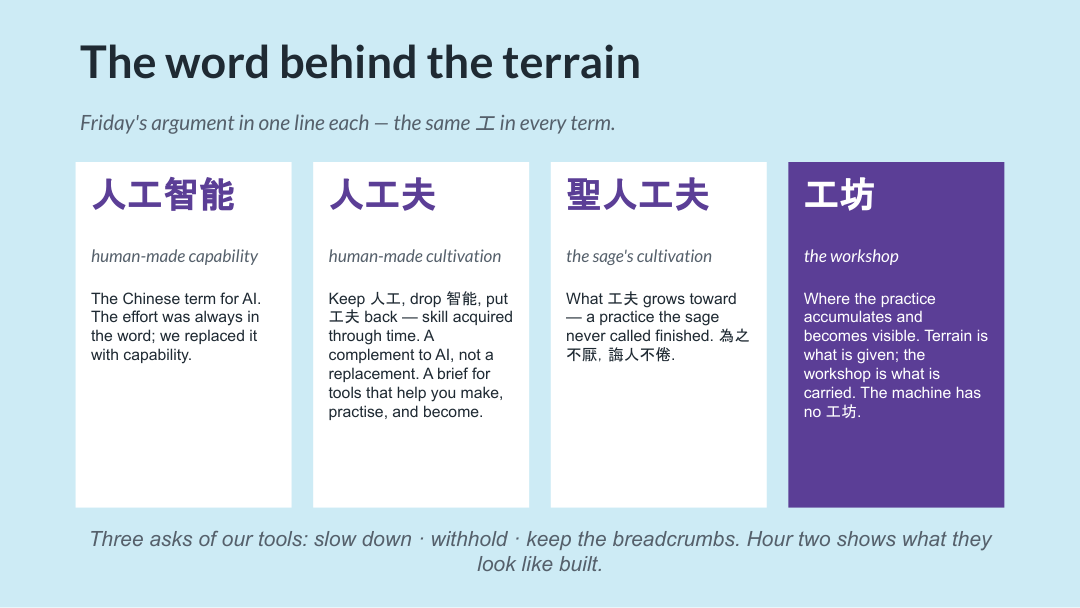
人工智能 is the Chinese term for artificial intelligence. Ruthmann’s proposed term, 人工夫 (rén gōngfu), keeps 人工, “human-made,” and brings 工夫—the time and effort of practice—into the foreground. Its working English gloss is “human-made cultivation.”
The question shifts from what a system can produce to what a person develops through using it: an ear for a musical choice, a technique that becomes available under the fingers, or a reason for revising a phrase.
Two further terms in the workshop design extend that idea: 聖人工夫, “the sage’s cultivation,” treats practice as ongoing; 工坊, “the workshop,” names a place where practice accumulates and becomes visible. These are the project’s conceptual starting points, offered for discussion and development.
Provide several musical possibilities. Let the learner listen, compare, change them or reject them all.
Put the decisions in sound: shaping a melody, hearing a harmonic color, or revising a rhythm. Adjust the challenge to the learner and the activity.
Preserve explorations, revisions and reasons for decisions, so learners and teachers can revisit how an idea developed.
The workshop expresses this brief as three asks of tools: slow down, withhold, and keep the breadcrumbs. Assistance should leave a next step that is worth practising.
A learner begins a phrase, explores alternative continuations, and decides what to keep, edit or write themselves. The design makes rejecting every suggestion an explicit choice.
Different harmonizations of one melody invite a judgment about which color serves the music. Comparing plausible alternatives gives the learner something musical to decide.
Decision logs and saved musical takes create material for reflection. Related MusEDLab tools already offer ways to revisit musical work: Virtual Piano Duet’s Melody Notebook and Fresh Annotator.
Led by S. Alex Ruthmann at NYU Shanghai, this work connects music education, creative learning design and Chinese philosophical vocabulary. Its prototypes are used to examine design choices and develop questions for classroom research.
The framework and prototypes remain in development. The examples describe design intentions, rather than established learning outcomes.
This overview draws on Ruthmann’s September 2026 workshop materials, Creative Learning Design in the Age of GenAI: From Completion to Cultivation.
You can browse without optional Google Analytics. Videos and other embeds load only when you click them.