MusEDLab / IMPACT / 2014
IMPACT 2014
August 13–16, 2014 · New York University
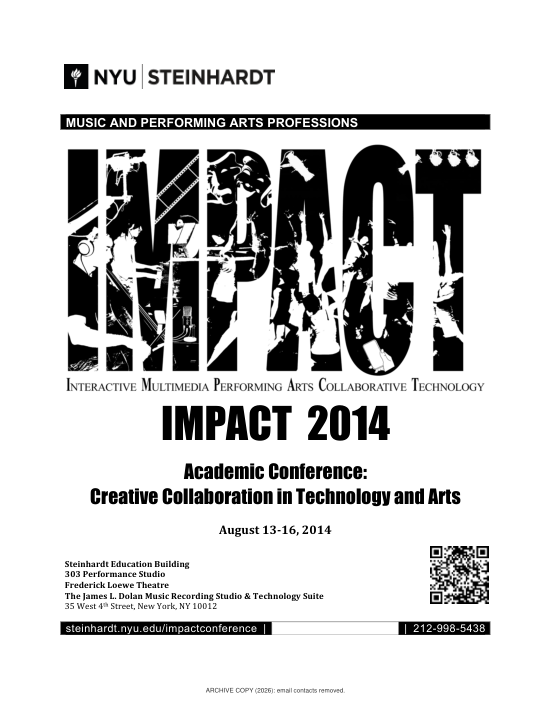
Program edition
Archive copy of IMPACTConference2014.pdf (27 pages). Email contacts have been removed. The separate multiweek IMPACT workshop, its history and faculty appear in the original booklet; they are related context, not additional conference sessions.
29 entries · 20 with descriptions
Joint NY Music Tech & Music Tech Educator Meetup
No separate presenter credit in this recordView record · description unavailable
No session description is available in the cited program record.
Banana pianos and musical cartoons: Learning music through making
Eric RosenbaumView record · description unavailable
No session description is available in the cited program record.
Movement and music: Applications of motion sensors in music and multimedia art
Jarrod Ratcliffe; Adriana MaddenRead description
Printed abstract heading: Bodies in Motion: Applications of Motion Sensors in Music and Multimedia Art
Printed abstract credits: Jarrod Ratcliffe and Adriana Madden – NYU
Physical gesture has been used in the design of musical controllers since the invention of the theremin in 1919, but gestural input has never been as accessible or affordable for public consumption as it is right now. The recent introduction of affordable consumer sensors has opened up vast opportunities for modern musicians and multimedia artists to creatively explore and extend traditional paradigms of musical and artistic expression. Consideration is given to collaborative artistic uses of sensors, and their ability to augment music, dance, theater, and visual art. Such uses can be seen within performance, production, installation and educational contexts. This interactive session provides an overview of gestural controllers, and gives participants the opportunity to interact with motion-controlled multimedia systems designed by the presenters. There will also be an open discussion where participants will have the opportunity to brainstorm the possible integration of sensors into their own projects.
Source program record · Abstract: PDF page 14 · Link to this session
Unpacking the DJ Mystique: An examination of the music making practices of EDM club DJs
Eva EgolfRead description
Printed abstract credits: Eva Egolf – NYU/City School District of New Rochelle
Early 1980s dance music genres, such as house and techno, have transformed and fractured into a myriad of subgenres and practices. Collectively, these genres are often grouped by the moniker electronic dance music (EDM). EDM historically, and currently, is performed in dance clubs by its hero, the disc jockey (DJ). As the genre’s popularity has increased, it has emerged from underground clubland to become an ubiquitous art form. Within the last five years EDM’s status has grown in the United States with expanded radio air time, and prominent EDM DJs such as David Guetta, Armin Van Buuren, Avicii, Afrojack, and Skrillex etching a place in popular music’s consciousness with their productions appearing on Billboard’s The Hot 100 list of popular songs. The purpose of this interactive session is to explore the music making processes of EDM club DJs. This project draws on findings from a case study of five local EDM DJs. The interactive session explores mixing techniques using Elliott's (1995,2014) framework for musical understanding. In addition to mixing techniques, the music making context, and programming approaches are described. Fieldwork video footage is used to illustrate musical examples. This presentation utilizes the format of a lecture demonstration, with time allotted for audience questions and experimentation.
Source program record · Abstract: PDF page 11 · Link to this session
New interactive listening technology for touch screens: Musical chairs: From spectator to stage
Leslie Linton; Mike GodwinView record · description unavailable
No session description is available in the cited program record.
Music composition as experience: New composition strategies for the modern classroom
Matt McLeanRead description
Printed abstract heading: Music Composition as Experience: New Composition Strategies for the Modern Classroom
Printed abstract credits: Matthew McLean - Young Composers & Improvisors Workshop at LREI
In the visual art class every student is an artist. Every student can now be a composer in music class. The art student develops skills and learns concepts through immediate experiences such as painting or drawing. With new technologies like the web app Noteflight and other iPad apps, music students can now benefit from the same kind of immediate experience. In this session, we’ll examine progressive techniques that help students explore music by being composers. The presentation includes video footage of students working and covers strategies for first time composers, through students working on their 4th compositions and beyond. The techniques can be summed up by the concept of "sound before theory." The strategies use technology or classroom instruments in a way that gives students the experience of “playing” with theoretical concepts in a hands on manner before having to codify or analyze them. We’ll examine how a project based composition project can meet every National Standard for music education. The presentation will also touch upon the three important components found to be necessary in successfully carrying out a composition curriculum on a classroom scale: a progressive curriculum, artists in residence and a community of online support. The strategies in this clinic have been realized while implementing a composition curriculum where since 2010 each and every 5th and 6th grade student at LREI has two compositions performed by professional musicians at two annual young composers concerts.
Source program record · Abstract: PDF page 13 · Link to this session
Panel on Popular Music Pedagogies
Jesse Rathgeber; Ethan Hein; Adam Bell; Eva Egolf; Jared O’Leary; Ryan BledsoeView record · description unavailable
No session description is available in the cited program record.
Making Music with the MaKey MaKey
Eric RosenbaumRead description
Printed abstract heading: MaKey MaKey Music: Beyond the Banana Piano
Printed abstract credits: Eric Rosenbaum; MIT Media Lab and JoyLabz
MaKey MaKey is an invention kit that lets you transform everday objects into computer keys. You can use it to make a game controller out of play-doh, a piano out of bananas, or whatever else you can imagine. In this hands-on workshop, you'll have a chance to make your own MaKey MaKey creations out of foil, foam, furniture, coffee cups, coins, clay, people, plants and more. We'll connect your creations with with music software to create new physical-digital musical instruments. We'll also reflect on how can we support learners as they get started with MaKey MaKey, and how to inspire them as they launch into ingenious new projects of their own.
Source program record · Abstract: PDF page 10 · Link to this session
Exploring Accessible New Interfaces for Digital Music Making and Learning
Ethan Hein; Jason Sigal; Jamie Ehrenfeld; Jay MateykoRead description
Printed abstract heading: Exploring Accessible New Interfaces for Digital Music
Printed abstract credits: Ethan Hein, Jason Sigal, Jamie Ehrenfeld & Jay Mateyko; NYU MusEDLab & Montclair State University
Participants will engage in hands-on experiences interacting with the NYU Steinhardt MusEDLab's new musical interfaces both in software and in the physical world that move beyond the piano keyboard metaphor. This workshop will present new and alternative visualization approaches that make abstract musical concepts more concrete and tangible in the context of inexpensive web interfaces and musical construction kits, allowing even young kids to create interfaces of their own.
Source program record · Abstract: PDF page 10 · Link to this session
21st Century Music Making for All Via the iPad
Adam GoldbergRead description
Printed abstract credits: Adam Goldberg; District 75, NYCDOE
In the four years since its release, the iPad has become a viable, widely accepted, powerful tool for music making. Reputable music manufacturers such as Korg, Moog, Yamaha, Propellerhead and many others are creating high quality apps for the iOS platform. These apps have a great deal of flexibility built into them, making them perfect for any educational or performance environment. In this workshop, experience hands-on how these apps can be modified and applied to meet the needs of any learner in any music making situation. Several apps will be explored, as well as some of the powerful Accessibility features built into the iOS platform. It is suggested that you bring your own iPad. A limited number will be provided for those who do not have their own.
Source program record · Abstract: PDF page 10 · Link to this session
IMPACT Performance
No separate presenter credit in this recordView record · description unavailable
No session description is available in the cited program record.
“Can we put that on iTunes?” Creating opportunities for learners to engage in authentic musical processes
Mike MedvinskyView record · description unavailable
No session description is available in the cited program record.
Creative play, musical learning, and middle school beta testers
Gena Greher; Eric RosenbaumRead description
Printed abstract heading: Creative Play, Musical Learning and Middle School Beta Testers
Printed abstract credits: Gena Greher – UMass Lowell & Eric Rosenbaum, MIT Media Lab
In collaboration with a graduate class action research project, we worked with middle school students using an iPad app called MelodyMorph that has a novel interface for making and playing musical instruments on the screen. The objective is to evaluate the teaching of musical concepts using this new technology in order to understand what they reveal about music cognition, and to develop ideas for future iterations of the technology. Music education students and the App designer brainstormed strategies for creating and introducing musical activities to the middle school students to support tune recognition, creating musical motifs and creating musical narratives. In addition to presenting several examples of student work, this hands-on interactive workshop will allow participants to explore several of the strategies that were developed over the course of this project, including the creation of musical puzzles to reconstruct tunes, creating music to accompany graphic drawings and musical soundscapes.
Source program record · Abstract: PDF page 12 · Link to this session
Interacting with 8-bit
Jared O’LearyRead description
Printed abstract credits: Jared O'Leary - Arizona State University
The early technological constraints imposed on 8-bit composers can act as project criteria for composing and performing 8-bit music that interacts with live 8-bit video games. This two hour session will begin with an interaction with 8-bit media and then break out into groups to create short musical excerpts and sound effects for a live video game. After all of the groups share what they created, the session concludes with a discussion on musical problems, technological constraints impacting creativity, and future projects.
Source program record · Abstract: PDF page 14 · Link to this session
App Petting Zoo
No separate presenter credit in this recordView record · description unavailable
No session description is available in the cited program record.
Making Music with the MaKey MaKey
Eric RosenbaumRead description
Printed abstract heading: MaKey MaKey Music: Beyond the Banana Piano
Printed abstract credits: Eric Rosenbaum; MIT Media Lab and JoyLabz
MaKey MaKey is an invention kit that lets you transform everday objects into computer keys. You can use it to make a game controller out of play-doh, a piano out of bananas, or whatever else you can imagine. In this hands-on workshop, you'll have a chance to make your own MaKey MaKey creations out of foil, foam, furniture, coffee cups, coins, clay, people, plants and more. We'll connect your creations with with music software to create new physical-digital musical instruments. We'll also reflect on how can we support learners as they get started with MaKey MaKey, and how to inspire them as they launch into ingenious new projects of their own.
Source program record · Abstract: PDF page 10 · Link to this session
Can We Put That On iTunes?
Mike MedvinskyRead description
Printed abstract credits: Mike Medvinsky; Bloomfield Hills Public Schools, Bloomfield Hills, Michigan
"Can We Put That On iTunes?" This hands-on workshop will extend the thinking talked about in my keynote. We will discuss how to creating opportunities for learners to engage in authentic musical processes. I will share examples from my own classroom as a launch for workshop participants to create, compose, and perform on mobile devices. I will have 8 iPads available, but participants are encouraged to bring their own. We will create original music and perform them for one another. If you would like to use your own device, we will be using the following apps: VidRhythm, MadPad, and GarageBand. We will discuss how engaging with learner/musicians in these practices have transformed my classroom culture from media curators to creators. Working within the soundtrack of learner's lives, this workshop is rooted in contemporary understandings of the nature of learning and teaching and authentic musical practices.
Source program record · Abstract: PDF page 10 · Link to this session
21st Century Music Making for All Via the iPad
Adam GoldbergRead description
Printed abstract credits: Adam Goldberg; District 75, NYCDOE
In the four years since its release, the iPad has become a viable, widely accepted, powerful tool for music making. Reputable music manufacturers such as Korg, Moog, Yamaha, Propellerhead and many others are creating high quality apps for the iOS platform. These apps have a great deal of flexibility built into them, making them perfect for any educational or performance environment. In this workshop, experience hands-on how these apps can be modified and applied to meet the needs of any learner in any music making situation. Several apps will be explored, as well as some of the powerful Accessibility features built into the iOS platform. It is suggested that you bring your own iPad. A limited number will be provided for those who do not have their own.
Source program record · Abstract: PDF page 10 · Link to this session
Robin Cox — HOURGLASS
Robin Cox; Jennifer DeVore; Stephanie Nugent; Lianne ArnoldRead description
HOURGLASS is a large scale work of fully composed music for live violin, cello, four channel electronic playback, and immersive video projection designed to engender community participation through movement improvisation. By active investment and involvement from attendees, HOURGLASS addressees ways to sustain extended participation in non-verbal and spontaneous communal activity, while representing an alternative performance concept for those lacking interest in experiencing arts through formal recital-style concerts.
Source program record · Abstract: PDF page 7 · Link to this session
The NYU MusEDLab: Designing technologies for meaningful musical experiences
Alex RuthmannView record · description unavailable
No session description is available in the cited program record.
Maker, participatory, and digital cultures in the classroom
Ryan BledsoeRead description
Printed abstract heading: Maker, Participatory, and Digital Cultures in the Classroom
Printed abstract credits: Ryan Bledsoe – Arizona State University
In this session, we will experience what a combination of maker, participatory, and digital cultures can look like in the classroom. An emphasis will be placed on collaborative, project-based learning that spans across the disciplines of the STEAM subjects. People of all ages are makers: makers of food, sounds, instruments, computer programs, tangible items, and much more. An important component of making something is having the space to play, explore, and experiment with materials—something that research shows us young children learn well from, but not something we often incorporate into classrooms and education past early childhood. Play, exploration, and experimentation are also important components of maker and participatory cultures, which can be used in conjunction with digital tools and aspects of digital culture to engage the students in our classrooms in ways that are authentic to real-life artistic practices. In this experience, participants will creatively interact with music, sound, and visual art in an analog, digital, and/or acoustic manner. Participants will design and create a multimedia piece with tools appropriate for elementary-aged students. We will explore the possibilities of making and using non- traditional musical scores in collaborative, improvisational music making. By using a graphical or visual score, barriers are deconstructed so that people with varying degrees of musical instruction can participate. Additionally, by designing and building their own instruments during this session, participants will encounter decision making in music not often associated with K-12 music classes such as timbre selection, instrument design, and controller design.
Source program record · Abstract: PDF page 11 · Link to this session
Record, upload, converse: Transforming assessment through Acclaim’s collaborative video platform
Jillian Harris Farrell; Aksel GungorRead description
Printed abstract heading: Record, Upload, Converse: Transforming Assessment Through Acclaim's Collaborative Video Platform
Printed abstract credits: Jillian Harris Farrell & Aksel Gungor - Acclaim
It is easy to feel overwhelmed by all the different web tools available to instructors: social media, blogs, and polls—the list goes on. Finding the right tool or platform, however, can transform assessment in the classroom or studio in situations where rubrics and score sheets may be not only ineffective but also inefficient and unscalable. Acclaim is a web platform that facilitates discussion and feedback around video content. Professors and students can securely add videos to the platform (recorded content or curated videos from the web) and then post time coded comments that highlight and link to specific parts of each video. Put simply, the platform makes it easy to annotate video content. Access can be shared among classmates and/or professors for a private, collaborative, and ultimately, constructive learning experience. For this interactive session, we will address the challenge of assessing performance using traditional methods and show how Acclaim can enhance the precision of instructor feedback and generate a constructive dialogue between teachers and students. We will record the session’s attendees engaged in two separate live performance experiences. One group will learn and perform a simple dance phrase, while the other group will read an excerpt of a dramatic monologue. Using Acclaim’s features, each group will then provide commentary on one another’s performances. The session will conclude with a question and answer period and a discussion of Acclaim’s potential applications in realms like music education, trial law, public speaking, and medicine.
Source program record · Abstract: PDF page 12 · Link to this session
Theory course for an all-online music education masters degree
Robinson McClellan; Stephen WilcoxRead description
Printed abstract heading: Theory Course for All-Online Music Education Masters Degree
Printed abstract credits: Robinson McClellan & Stephen Wilcox - Rutgers University, Mason Gross Arts Online
BRING YOUR LAPTOP or IPAD This online masters course in music education at a large university serves to deepen the practical theory knowledge of future music educators while teaching them to teach via peer assessment and several online tools. IMPACT conference participants in our interactive session will complete a short musical analysis via the basic process used in our course design, in miniature form: • First, participants ‘Teach the Material’ by individually creating analyses of a short passage in (guided) blog form. • Students take the role of teachers for the second stage of the process, ‘Teach the Teacher,’ providing feedback on one another’s mini-blog analyses via a rubric. • Based on this feedback, each student creates a follow-up in the form of a description detailing how he or she would teach the piece to student performers, or a lesson plan. In the real course, instructors then grade students both for their analyses and for the quality of the teaching feedback they provide to their peers. Groups rotate through the semester in three-week cycles, creating multiple opportunities for interaction and sharing. All this work is bolstered by an online ‘textbook’ (written lessons) and semester-long assignments in which students read and react to scholarly articles on music analysis. Today’s teaching environment requires competence with basic music instructional technology such as notation software (for this course, Noteflight), web interactions and audio/video recording. These technologies and their uses in teaching are included as a built-in aspect of the coursework.
Source program record · Abstract: PDF page 13 · Link to this session
Dialogue with a controller: Projects, pilot-testing, and pedagogy
Jesse RathgeberRead description
Printed abstract heading: Dialogue with a Controller: Projects, Pilot-Testing, and Pedagogy
Printed abstract credits: Jesse Rathgeber – Arizona State University
Tools like Scratch and Makey-Makey afford us new ways to think about and create music. With these tools, we can construct new controllers and interfaces that allow us to play with our own sounds on our own terms. We can craft motion controllers that let us interact with sound through gesture. We can design touch interfaces that power interactive art installations. The possible outcomes of our interaction with these tools are diverse and imaginative. Yet, these creative products are but artifacts of intense, complex, and often meaningful creative processes. This session explores curricular applications of using Scratch and Makey-Makey to create interactive sound installations with a focus on the process of creating the works. We will explore a pedagogical framework for crafting such works that embraces pilot-testing, iterative design, and collaborative problem solving. Through hands-on engagement with these tools, we will uncover how such a framework can empower students to engage in dialogue with one-another, the potential users of their of their works, and even the works themselves.
Source program record · Abstract: PDF page 14 · Link to this session
Fresh Ed: It’s bigger than Hip Hop
James Miles; Jamel Mims; Michael WigginsRead description
Printed abstract heading: Fresh Ed: It's Bigger than Hip Hop
Printed abstract credits: James Miles, Jamel Mims, & Michael Wiggins – Urban Arts Partnership
Fresh Prep: It's Bigger than Hip Hop" is an interactive Regents Prep event that uses culturally responsive hip hop pedagogy and process drama to prepare students for the Global and US History Regents Exam. Harnessing the mnemonic elements of original hip hop music, accessing knowledge pop culture, and theatrical techniques, participants will come alive in a creative and musical world of learning.
Source program record · Abstract: PDF page 14 · Link to this session
Integrating Computer Music into your Secondary School Performance Ensemble
Evan CombsRead description
Printed abstract credits: Evan Combs – Connections Education/Juilliard
As a perpetual field, computer music has continued to develop in university music programs at an exponential rate. However, these technologies, theories, and implementations have been struggling to integrate into secondary schools. This session will explore the unique opportunities we, as music educators, can give students to explore and embrace computer music through ensemble performances, engaging Generation Z. Studying the accessible technologies of the twenty-first century classroom provides a better grasp of what tools and methods should be incorporated in our music curriculum, and available for performance use. Primarily focusing on the use of technology (laptops, smart devices, and video projection) as an instrument and controller in ensembles, the session will cover design methods and ways to develop your own software and app environments for creating and manipulating a variety of new data. This discussion will apply to Open Sound Control (OSC), cross-platform music technology software, and languages with open-source alternatives. Participants will take the provided steps to designing a secondary level computer music performance piece. When complete, the group will discuss and evaluate each project’s logistics, identifying its hardware and software requirements, accessibility, and educational value.
Source program record · Abstract: PDF page 11 · Link to this session
Sound and Sight
Jun LiRead description
Printed abstract credits: Jun Li - Montclair State University
The digital evolution of communication and ever-increasing performance of the computer have transformed the visual communication design field into a discipline that synthesizes aural and visual, spatial and temporal elements. Digital technology provides new expressive possibilities for artists working in audio-visual media. The interactive session Sound and Sight engages visual representations of sound, space, and rhythm. Participants will select a sound sequence containing a variety of distinguishable motives and/or themes. The design process consists of identifying different dimensions of contrast in music and working in Max and Processing to simultaneously generate graphic compositions linking image and sound in a synaesthetic relationship. In addition, participants will edit the generated visual sequence, synchronize the audio, and add texts in Adobe AfterEffects.
Source program record · Abstract: PDF page 13 · Link to this session
Plink Out: Interacting, Learning, and Playing with Color Fretboard Visualizations
Kevin Irlen; Keith PatchelRead description
Printed abstract heading: PlinkOut: Interacting, Learning and Playing with Color Fretboard Visualizations
Printed abstract credits: Keith Patchel & Kevin Irlen – Modulus Media, Inc.
PlinkOut is an AudioVisual interface that runs in a web browser. PlinkOut is an online/mobile application which uses sight, sound, color, and motion graphics to teach anyone the core cognitive ideas of music. PlinkOut can be used by children in school, advanced adults, and any music lover at any level, anywhere, anytime. Singing and practicing the musical patterns in PlinkOut will teach the end user how to play an instrument, how to read music, how to understand music theory, and eventually, how to compose.
Source program record · Abstract: PDF page 14 · Link to this session
Closing Session
No separate presenter credit in this recordView record · description unavailable
No session description is available in the cited program record.
No entries match. Clear the filters to see the full program.
Historical text is retained, including period language and product availability. Printed program pages also contain breaks, registration and related workshop context.